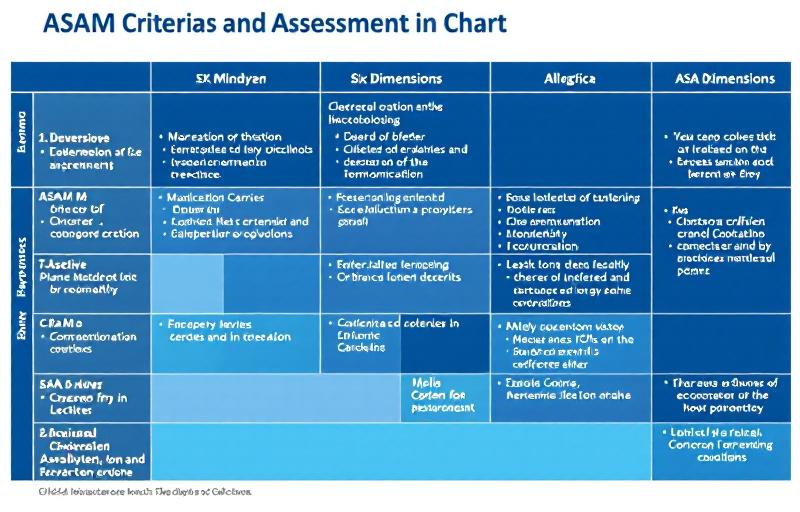
What Are the ASAM Criteria?
The ASAM Criteria—developed and maintained by the American Society of Addiction Medicine—represent the most widely used and comprehensive set of guidelines for patient placement, continued stay, transfer, and discharge in the treatment of substance use disorders and co-occurring conditions. Currently in their fourth edition (published 2023), these criteria are used by clinicians across all 50 states and are mandated or recommended by the majority of state regulatory agencies and insurance providers.
Unlike a simple checklist, the ASAM Criteria provide a multidimensional assessment framework that considers the whole person—not just the substance being used or the frequency of use. The goal is to match each individual to the level and type of care most likely to produce positive outcomes, following the principle that treatment should be provided at the least restrictive level that is safe and effective.
For patients seeking treatment, understanding the ASAM Criteria can demystify the assessment process and help set realistic expectations about what type of program a clinician may recommend. For families, it provides a framework for understanding why a loved one might need inpatient care versus outpatient treatment, or why a recommendation might change over time.
The Six Assessment Dimensions
The ASAM Criteria evaluate patients across six distinct but interrelated dimensions. Together, these dimensions create a comprehensive clinical picture that guides treatment placement decisions. No single dimension determines the outcome; rather, clinicians weigh the combined severity across all six to identify the most appropriate level of care.
According to SAMHSA's endorsement of the ASAM Criteria, this multidimensional approach produces more accurate placement decisions than earlier models that relied primarily on substance type or pattern of use. Research published in the Journal of Addictive Diseases found that patients placed according to ASAM guidelines were 30% more likely to complete treatment than those placed without structured criteria.
Dimension 1: Acute Intoxication and/or Withdrawal Potential
The first dimension assesses the patient's current state of intoxication, the risk of withdrawal symptoms, and the medical severity of any anticipated withdrawal syndrome. This is often the most urgent dimension, as certain types of withdrawal—particularly from alcohol, benzodiazepines, and barbiturates—can be life-threatening without medical supervision.
Clinicians evaluate factors including the specific substance(s) used, the amount and frequency of recent use, the time since last use, and the patient's history of previous withdrawal episodes. A patient with a history of alcohol withdrawal seizures, for example, would likely require a higher level of care for detoxification than someone experiencing mild opioid withdrawal for the first time.
Tools such as the Clinical Institute Withdrawal Assessment for Alcohol (CIWA-Ar) and the Clinical Opiate Withdrawal Scale (COWS) provide standardized scoring to complement clinical judgment. Importantly, Dimension 1 also considers polydrug use, which can complicate withdrawal management and increase the need for medically intensive monitoring.
Dimension 2: Biomedical Conditions and Complications
This dimension examines any physical health conditions that may affect treatment or be affected by treatment. Chronic conditions such as hepatitis C, HIV/AIDS, diabetes, cardiovascular disease, and chronic pain are common among individuals with substance use disorders and can significantly influence treatment planning.
The assessment considers whether the patient's medical conditions are stable or unstable, whether they require active medical management during treatment, and whether the treatment setting can safely accommodate those needs. A patient with uncontrolled diabetes or active liver disease, for example, may require placement in a program with on-site medical staff and laboratory monitoring capabilities.
Pregnancy is another critical consideration in Dimension 2. Pregnant patients with opioid use disorder require specialized care, including medication-assisted treatment with buprenorphine or methadone, which has been shown by NIDA research to improve outcomes for both mother and child compared to medically supervised withdrawal alone.
Dimension 3: Emotional, Behavioral, or Cognitive Conditions
The third dimension evaluates the patient's mental health status, including any co-occurring psychiatric disorders, cognitive impairments, or behavioral issues that could affect treatment engagement and outcomes. This dimension is critical because substance use disorders and mental health conditions frequently co-occur—SAMHSA estimates that approximately 9.2 million adults in the U.S. have a co-occurring substance use and mental health disorder.
Clinicians assess for conditions including major depressive disorder, bipolar disorder, anxiety disorders, PTSD, personality disorders, and psychotic disorders. They also evaluate for suicidal ideation, self-harm behaviors, and cognitive deficits that may affect the patient's ability to participate in treatment activities.
The severity of co-occurring conditions heavily influences level-of-care decisions. A patient with active suicidal ideation and alcohol dependence, for instance, may require inpatient psychiatric stabilization before transitioning to addiction-focused treatment. Conversely, a patient with stable, well-managed depression may be appropriately served in an outpatient setting.
Dimension 4: Readiness to Change
Dimension 4 assesses the patient's motivation, readiness, and willingness to engage in treatment and make behavioral changes. Drawing on the Transtheoretical Model of Change (Prochaska and DiClemente), clinicians evaluate where the patient falls on the spectrum from pre-contemplation (not yet recognizing the need for change) to action (actively working toward recovery).
This dimension does not penalize patients who are ambivalent about treatment. Instead, it recognizes that motivation is a dynamic state that can be influenced by the treatment experience itself. A patient in the contemplation stage—aware that a problem exists but not yet committed to action—may benefit from motivational interviewing techniques in an outpatient setting, while a patient with minimal insight may require a more structured environment to engage in the therapeutic process.
External motivators are also considered. Patients who are court-ordered to attend treatment, for example, may initially have low intrinsic motivation but can develop genuine engagement through the therapeutic process. Research shows that treatment outcomes for mandated patients are comparable to those for voluntary patients when the treatment is evidence-based and of sufficient duration.
Dimension 5: Relapse, Continued Use, or Continued Problem Potential
This dimension evaluates the patient's historical pattern of substance use, including relapse triggers, relapse history, the ability to maintain gains from previous treatment episodes, and awareness of personal risk factors. It addresses the question: How likely is this patient to continue using or relapse without a particular level of support?
Clinicians consider factors such as the chronicity and severity of the substance use disorder, the number of previous treatment episodes, the length of any sustained periods of recovery, and the patient's ability to identify and manage triggers. A patient with multiple prior treatment failures, rapid relapse patterns, and limited coping skills may require a more intensive level of care than someone entering treatment for the first time with a shorter history of use.
This dimension also incorporates the concept of relapse prevention readiness—the extent to which the patient has developed or can develop practical strategies for maintaining sobriety. Patients who demonstrate strong relapse prevention skills may be appropriate for step-down to less intensive care sooner than those who are still building these capabilities.
Dimension 6: Recovery/Living Environment
The sixth and final dimension examines the patient's external environment and its impact on recovery. This includes the patient's living situation, family dynamics, social support network, employment status, and exposure to environmental triggers such as neighborhoods with high drug availability or social circles that revolve around substance use.
A patient who has stable housing, supportive family members, and a drug-free social network may be safely served in an outpatient setting. In contrast, a patient who is homeless, surrounded by active users, or living in a domestic violence situation may need residential treatment simply to remove them from an environment that makes recovery impossible.
This dimension also considers the availability of sober living arrangements and recovery support services in the patient's community. When the recovery environment is deficient, clinicians may recommend a higher level of care not because of the patient's clinical severity, but because adequate community-based support is unavailable.
The Levels of Care
Based on the multidimensional assessment, clinicians assign patients to one of several defined levels of care. The ASAM framework organizes these levels on a continuum of intensity:
Level 0.5 — Early Intervention: Prevention and screening services for individuals who are at risk but have not yet developed a diagnosable substance use disorder.
Level 1 — Outpatient Services: Less than 9 hours of service per week, typically consisting of individual and group therapy sessions. Appropriate for patients with stable living environments, moderate motivation, and lower clinical severity.
Level 2.1 — Intensive Outpatient (IOP): 9–19 hours of structured programming per week, allowing patients to maintain work and family responsibilities while receiving intensive treatment. Learn more about IOP vs. inpatient.
Level 2.5 — Partial Hospitalization: 20 or more hours per week of clinically intensive programming, designed for patients who need more structure than IOP but do not require 24-hour supervision.
Level 3.1 — Clinically Managed Low-Intensity Residential: Often referred to as sober living or halfway house programs, providing a structured living environment with clinical support.
Level 3.5 — Clinically Managed High-Intensity Residential: 24-hour care with trained staff, appropriate for patients with significant cognitive or functional impairments.
Level 3.7 — Medically Monitored Intensive Inpatient: 24-hour nursing care with physician availability, providing medical monitoring and clinical services for complex cases.
Level 4 — Medically Managed Intensive Inpatient: Hospital-based care with 24-hour medical and nursing services, reserved for the most clinically severe presentations requiring acute medical management.
Case Examples
Case 1: Maria, 34, Alcohol Use Disorder
Maria has been drinking heavily for three years, consuming 8–10 drinks daily. She has no history of withdrawal seizures but reports mild tremors when she stops drinking. She has stable employment, a supportive spouse, and no co-occurring mental health diagnoses. Her ASAM assessment indicates moderate Dimension 1 risk (withdrawal), low Dimensions 2–4, moderate Dimension 5 (first treatment attempt), and strong Dimension 6 (stable environment). Recommended placement: Level 3.7 medically monitored inpatient for detoxification, followed by step-down to Level 2.1 IOP.
Case 2: David, 28, Opioid Use Disorder + PTSD
David is a veteran who developed an opioid use disorder following a service-connected injury. He has been using heroin for 18 months and reports daily use. He has PTSD with recurrent nightmares and hypervigilance, has attempted treatment twice before with relapse within weeks of discharge, and is currently homeless. His assessment shows high severity across Dimensions 1, 3, 5, and 6. Recommended placement: Level 3.7 with integrated dual-diagnosis programming, transitioning to Level 3.1 sober living with continued trauma-informed outpatient care.
Case 3: Jennifer, 45, Prescription Stimulant Misuse
Jennifer has been misusing her prescribed ADHD medication (amphetamine salts) for approximately six months, taking 2–3 times the prescribed dose. She has no withdrawal risk, stable health, mild anxiety, strong motivation for change, no prior treatment, and a supportive home environment. Her assessment indicates low severity across all six dimensions. Recommended placement: Level 1 outpatient treatment with medication management and CBT.
Why ASAM Matters for Patients and Families
Understanding the ASAM Criteria empowers patients and families to be informed participants in treatment decisions. When a clinician recommends a specific level of care, knowing the framework behind that recommendation can reduce anxiety, build trust, and improve treatment engagement.
It is also important for navigating insurance discussions. Most insurance providers use ASAM-based criteria to make coverage decisions, and understanding the six dimensions can help patients and advocates articulate why a particular level of care is medically necessary. If an insurance company denies coverage for recommended treatment, knowledge of ASAM guidelines strengthens the appeal process.
Finally, the ASAM framework reinforces a fundamental truth about addiction treatment: there is no one-size-fits-all approach. The most effective treatment is the treatment that matches the individual's unique combination of clinical, psychological, social, and environmental needs—and the ASAM Criteria provide the most evidence-based tool available for making that match.
Get a Personalized Assessment
Our team can help you understand your treatment options based on your unique situation. Call us for a free, confidential consultation.
(855) 312-7200Sources
- American Society of Addiction Medicine. (2023). The ASAM Criteria: Treatment Criteria for Addictive, Substance-Related, and Co-Occurring Conditions, 4th Edition.
- SAMHSA. (2023). ASAM Criteria Resource Page.
- NIDA. (2023). Medications to Treat Opioid Addiction.
- Journal of Addictive Diseases. (2019). ASAM Criteria-Based Placement and Treatment Outcomes.